

Table of Contents
- OEM Toyota Truck Parts for Restoration: What to Buy First
- OEM vs Aftermarket Toyota Parts: Fitment and Value
- Toyota Truck Parts by VIN: How to Verify Fitment
- Sourcing Older Toyota Truck Parts by Generation
- Used OEM Toyota Parts: What to Inspect Before Buying
- Restoration Parts by System: Engine, Drivetrain, Body, and Electrical
- Pricing and Availability: What Restoration Parts Cost
- Conclusion: Building Your Restoration Parts List
- Frequently Asked Questions
Last Updated: October 12, 2026
OEM Toyota Truck Parts for Restoration: What to Buy First
Restoring a Toyota truck starts with one decision: buy safety and drivetrain parts first, then cosmetics. At Bayou Garage Supply, we understand the importance of prioritizing functional components in a restoration. Brakes, cooling, suspension, and engine fasteners come first, a truck that stops and cools properly is one you can keep working on.
Genuine OEM Toyota truck parts for restoration are built to the manufacturer's original specifications for your truck's model year, trim, and driveline. They differ from aftermarket parts in fitment tolerances and material consistency, the difference between a part that bolts on the first time and one that comes back off.
A common mistake is buying by model name alone. A 1989-1995 pickup headlight, a 2005-2015 Tacoma rear shock, and a 2010-2021 radiator all carry different year windows.
| Priority | System | Why It Comes First | Typical First Purchase |
|---|---|---|---|
| 1 | Brakes and safety | A truck that will not stop is not restorable | Inspection before any parts order |
| 2 | Cooling | Overheating damages engines during test drives | Radiator and hoses |
| 3 | Suspension and chassis | Worn mounts and springs hide other faults | Body mounts, leaf springs |
| 4 | Engine fasteners | Rebuilds fail on reused stretch bolts | Flywheel bolt kit |
| 5 | Body and trim | Cosmetic work is wasted on a non-runner | Grilles, headlights |
OEM vs Aftermarket Toyota Parts: Fitment and Value
OEM vs aftermarket Toyota parts comes down to tolerance, documentation, and validation, not brand loyalty. Genuine parts are built to the original drawing for your truck's year, trim, and driveline, so mounting points, connector pins, thread pitches, and material specs match the assembly line.
Here is the distinction that matters:
| Type | What It Is | How to Identify It | Best Used For | Main Risk |
|---|---|---|---|---|
| Genuine OEM (new) | Built to the manufacturer's original specification, sold through dealer or authorized channels | Factory part number on the box and often on the part; consistent casting marks; factory-style packaging | Safety systems, sensors, connectors, anything with a bracket or tight clearance | Cost and discontinued availability |
| New old stock (NOS) | Genuine parts produced years ago but never installed | Factory part number, older packaging, shelf wear, sometimes a superseded number on the label | Discontinued trim, emblems, and hardware where reproduction does not exist | Rubber and plastic age even in the box |
| Reproduction | Newly manufactured copies of discontinued originals | Seller's own part number, not a factory number; finish and material often differ | Body panels, grilles, trim, and cosmetic pieces | Fitment and finish vary widely by maker |
| Used OEM | Genuine parts pulled from a donor truck | Casting or stamping number visible on the part; wear patterns consistent with mileage | Housings, brackets, hard-to-find castings, and driveline cores | Hidden corrosion, stripped threads, fatigue cracks |
| Aftermarket | Independently engineered replacements | Manufacturer's own number and branding; may cross-reference an OEM number | Common wear items, consumables, and performance upgrades | Inconsistent quality between brands and batches |
Where aftermarket wins: price and availability on common wear items like filters, belts, hoses, and brake pads. Where it loses: anything with a connector, bracket, tight clearance, or calibration.
Reproduction parts sit in between: they copy original dimensions for discontinued items, but material and finish often differ.
Fitment is the real cost driver. A part that does not bolt up costs return shipping, downtime, and sometimes stripped hardware. A seller who lists only 'fits Toyota pickup' has verified nothing.

Toyota Truck Parts by VIN: How to Verify Fitment
Toyota truck parts by VIN is the only lookup method that accounts for how your specific truck was built. The VIN encodes model, model year, plant, and driveline configuration, so a VIN-based search returns parts matching your actual build rather than a generic year range.
To verify fitment, consider these steps:
- Find the VIN plate on the driver's side door jamb and the stamped VIN on the frame.
- Decode the VIN to confirm model year, trim, and driveline (4x2 or 4x4).
- Pull the OEM part number from a VIN-based catalog.
- Cross-check the part number against the number stamped or molded on your old part.
- Confirm the part number is listed.
- Ask for a photo of the actual part and its casting or stamping marks.
A photo of the real casting number can be helpful with used parts.
Sourcing Older Toyota Truck Parts by Generation
Older Toyota truck parts fall into three eras, each with a different supply reality. Knowing the generation tells you whether to hunt new old stock, reproduction, or clean used.
| Generation | Approximate Years | Body Style | Sourcing Reality |
|---|---|---|---|
| Fourth gen Hilux/Pickup | 1984-1988 | Solid axle, 4x2 and 4x4 | Hardest to find; reproduction and used dominate |
| Fifth gen Pickup | 1989-1995 | Independent front suspension | Moderate; some new parts still listed |
| First gen Tacoma | 1995-2004 | 4x2 and 4x4, multiple trims | Easiest; broad new and used supply |
| Second gen Tacoma | 2005-2015 | 4x2 and 4x4 | Strong supply, including suspension |
| Third gen Tacoma | 2016-present | 4x2 and 4x4 | Dealer-supported |
For the 1980-1990 window, suspension is where restoration stalls. SPRING LEAF TOYOTA fits Toyota models from 1980 to 1990 with a 2.25-inch lifted ride height and a 480 lbs./in. spring rate, the kind of narrow fitment window generic listings get wrong.
Used OEM Toyota Parts: What to Inspect Before Buying
Used OEM Toyota parts are often the only realistic option for discontinued components, but condition grading varies wildly. Inspect these before you commit:
- Casting or part numbers, to confirm the part is what the listing claims
- Corrosion on aluminum housings, especially around coolant passages
- Thread condition on every mounting hole and fastener boss
- Cracks at stress points, particularly on brackets and mounts
- Connector pins and pigtails on anything electrical
- Wear surfaces on suspension and driveline components
Ask three questions before buying: what vehicle did this come off, what is the part number, and what is the return policy.
For chassis work, TOYOTA BODY MOUNT SET shows what a complete, correctly specified set looks like: part number 84109G, 6.343 lbs, with a stated fitment.
Bl Toyota Pickup 89-95 - 511019 →

Restoration Parts by System: Engine, Drivetrain, Body, and Electrical
Restoration parts by system break into groups, each with its own sourcing logic. Engine and drivetrain parts reward genuine or high-quality replacements because failure costs are high.
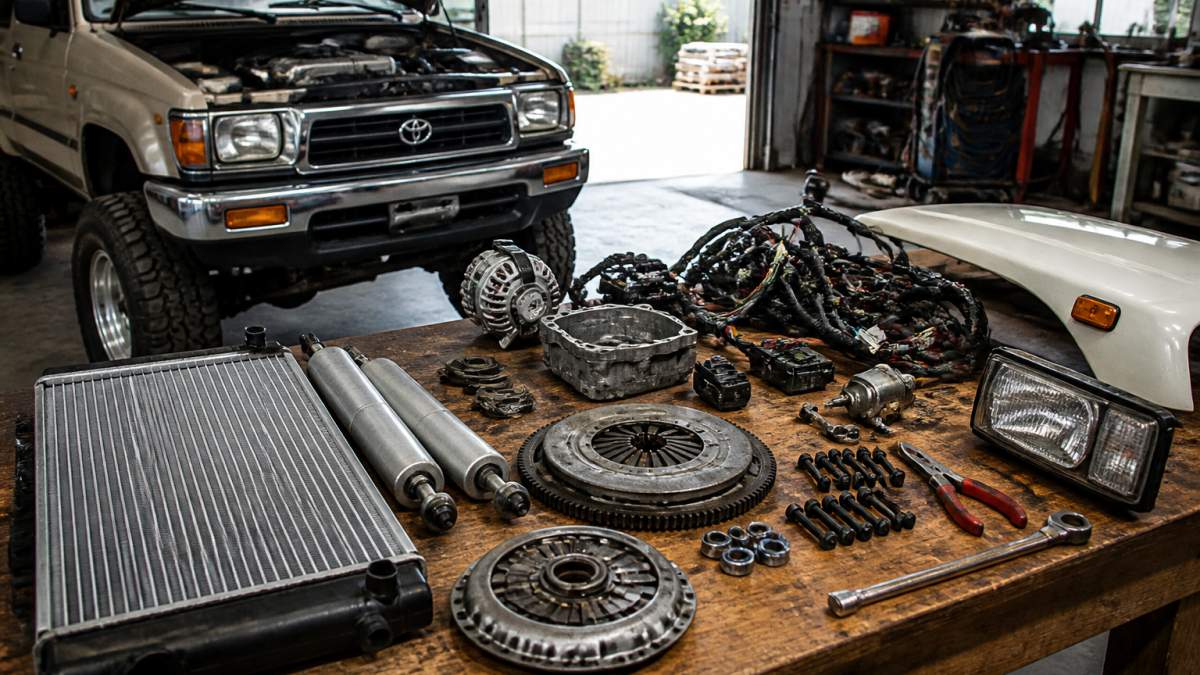
Engine and maintenance parts. Cooling comes first, because a truck that overheats during test drives will not survive break-in. A downflow aluminum radiator like Radiator Aluminum Downflow Toyota - 7212 uses a downflow configuration for coolant circulation and aluminum for corrosion resistance. For 2010-2021 models, RADIATOR ALUM TOYOTA 2ROW adds a two-row core and included transmission cooler for automatics. During any rebuild, replace one-time-use hardware: Toyota Flywheel Bolt Kit - 2032802 uses high-strength material that resists stretching, and torque-to-yield fasteners should never be reused.
Drivetrain and chassis. Body mounts and springs carry the truck's weight and control how it tracks. TOYOTA BODY MOUNT SET minimizes body roll and reduces road noise through a firmer body-to-frame connection. For 4x4 trucks on rough roads, 4600 Toyota Light Truck - 24011402 is a Bilstein 4600 shock built for Toyota light trucks.

Body and exterior. 2001-2004 Toyota Tacoma Grill p# TO1200248 is manufactured to OEM specifications with no cutting or drilling required. Body Parts Grilles - TO1200297 matches stock factory style and requires painting.
Electrical and lighting. Bl Toyota Pickup 89-95 - 511019 is an ANZO headlight unit for the 1989-1995 pickup, weighing 0.83 lbs. Used electrical parts carry the most risk: connector pins corrode, pigtails get cut, and previous owners splice in whatever was on hand.
Interior and accessories. Seats, door panels, dash pads, and carpet are almost always reproduction or reupholstered rather than new OEM, since originals were discontinued decades ago. Focus on function first: window regulators, door latches, and heater controls determine whether the truck is usable.
Pricing and Availability: What Restoration Parts Cost
Restoration parts pricing tracks three things: whether the part is still produced, how narrow the fitment window is, and shipping weight. Narrow-window parts cost more because fewer units move; heavy parts cost more because freight adds up.
Our current catalog across categories:
| Part | Category | Price | Fitment Window |
|---|---|---|---|
| Bl Toyota Pickup 89-95 - 511019 | Lighting | $46.79 | 1989-1995 pickup |
| Toyota Flywheel Bolt Kit - 2032802 | Fasteners | $76.79 | Toyota engines |
| 4600 Toyota Light Truck - 24011402 | Suspension | $134.39 | Toyota light trucks |
| TOYOTA TACOMA 4WD REAR SHOCKS | Suspension | $152.39 | 2005-2015 Tacoma 4WD |
| TOYOTA BODY MOUNT SET | Chassis | $179.15 | Toyota vehicles |
| 2001-2004 Toyota Tacoma Grill p# TO1200248 | Body | $225.58 | 2001-2004 Tacoma |
| Body Parts Grilles - TO1200297 | Body | $244.78 | Toyota models |
| SPRING LEAF TOYOTA | Suspension | $302.38 | 1980-1990 Toyota |
| Radiator Aluminum Downflow Toyota - 7212 | Cooling | $760.79 | Toyota models |
| RADIATOR ALUM TOYOTA 2ROW | Cooling | $908.39 | 2010-2021 Toyota |
Conclusion: Building Your Restoration Parts List
The hardest part of a Toyota truck restoration is not finding parts. It is sequencing them so you are not buying the same component twice because the first one did not fit. Verify by VIN, confirm the generation, and buy safety and drivetrain parts before cosmetics. For discontinued components, ask for photos of the actual casting numbers before you pay.
At Bayou Garage Supply, we offer a comprehensive selection of automotive parts, specializing in both new and used OEM components for trucks and SUVs. Our catalog includes essential engine, transmission, suspension, and body parts designed to keep your vehicle running at its best. We serve automotive enthusiasts and repair needs by providing reliable, high-quality replacement parts for various makes and models, including Toyota. Browse specific Toyota replacement parts online and source used OEM parts via eBay.
Frequently Asked Questions
Are OEM parts better than aftermarket parts for a Toyota truck restoration?
For restoration, OEM parts are made to the original factory specifications, so they fit and function like the parts that came on the truck. Aftermarket parts vary in quality and may need modification. For critical components like engine internals, transmission parts, and body panels, OEM or high-quality reproduction parts are usually worth the extra cost. For wear items like shocks or brakes, quality aftermarket options can work well.
How do I find OEM parts for an older Toyota truck?
Start with your truck's VIN and look up the OEM part number using a Toyota parts catalog or a VIN decoder. Once you have the number, search specialty suppliers that stock new old stock, used OEM, or reproduction parts. For discontinued items, check restoration forums and parts networks. Bayou Garage Supply stocks used OEM components for older Toyota trucks, including suspension and chassis parts.
How can I check whether a Toyota part fits my truck?
Use the VIN to confirm the exact model year, trim, and driveline. Then compare the OEM part number on the part or its listing to the number your VIN lookup returns. Check bolt patterns, connector types, and dimensions for body and electrical parts. When buying used OEM Toyota parts, consider asking the seller for the donor vehicle's VIN and photos of the part number stamp.
Which Toyota truck parts are worth buying OEM for a restoration?
Prioritize OEM for engine internals, transmission and transfer case components, electrical sensors, and body panels where fitment is critical. For suspension wear items like shocks and leaf springs, quality aftermarket brands such as Bilstein and Old Man Emu are common restoration choices. For cosmetic parts like grilles, OEM-spec reproduction parts can save money while maintaining a factory look.